





How Colour Is Born in Lab-Grown Diamonds
Colour in a diamond is not a surface finish or a dye applied after growth. It is the visible result of physical events that happen inside the crystal at the atomic level — and once fixed, that colour remains stable for the entire life of the stone.
Understanding where colour comes from changes how you choose a diamond. It moves the conversation from aesthetics to science, and from marketing language to something more honest and useful.
Colour as a Structural Phenomenon
Every diamond is a tightly ordered lattice of carbon atoms. In a colourless stone, this structure is as close to perfect as possible — minimal impurities, minimal distortions, maximum transparency.
In a coloured diamond, that same lattice contains deliberate imperfections. These may be trace atoms of other elements incorporated during growth, tiny distortions caused by internal stress, or vacancies where an atom has been displaced. Each type of imperfection changes how the crystal absorbs and reflects light — and the eye perceives what remains as a specific hue.
This is not pigment. It cannot be washed away, scratched off, or altered through normal wear. Colour exists throughout the entire volume of the crystal, not just on the surface.
In lab-grown diamonds, the same physics applies. The difference is control: technology allows colour to be designed with a precision and repeatability that geological chance simply cannot offer.
Blue: Boron and the Absorption of Red
Blue colour forms when trace amounts of boron are incorporated into the diamond lattice during growth. Boron changes the electronic structure of the crystal, shifting the absorption spectrum so that part of the red wavelengths are absorbed and the reflected light appears blue. This is known as a growth colour — it forms simultaneously with the crystal itself, not through any later treatment.
In the laboratory, boron is introduced directly into the growth environment during HPHT or CVD processes. Precise control of pressure, temperature and chemical composition makes it possible not only to produce blue, but to design its tone, saturation and uniformity in advance.
The range of achievable shades runs from very light sky blue and icy blue through azure, cornflower, steel blue, royal blue and deep dark blue. Undertones — purplish, grayish, greenish — play a decisive role in how valuable and visually refined the result appears. Purplish undertones tend to deepen and ennoble. Grayish undertones make colour appear cold and muted. Greenish shifts reduce visual purity.
Yellow: Nitrogen as a Design Instrument
Yellow colour arises when nitrogen atoms are incorporated into the crystal lattice. Nitrogen absorbs the blue part of the spectrum, producing a warm yellow visual response. Like blue, this is a growth colour — it forms as the crystal grows, not after.
In HPHT synthesis, nitrogen concentration can be precisely regulated from the start, allowing tone and saturation to be designed rather than discovered. In some cases, post-growth treatment is applied to fine-tune the shade. All such methods are always disclosed in the certificate.
Lab-grown yellow diamonds offer a wide, clean palette: from cold lemon and canary through sunny, golden, honey and yellow-orange. Compared to natural stones, they typically show purer colour, higher clarity, larger sizes and better visual predictability — which matters when you are designing a piece around a specific shade.
Pink: Colour Born from Deformation
Pink is the most structurally complex colour in diamonds. It does not originate from a chemical impurity but from microscopic plastic deformation of the lattice — tiny shifts in atomic positions that create a specific absorption band and modify the spectral response.
Because very small structural changes can produce dramatic differences in tone and saturation, two pink diamonds of the same weight and clarity can look entirely different. This sensitivity also extends to cut: deeper geometries intensify saturation, while shallower cuts create a pastel effect. Cushion and radiant cuts concentrate colour; oval and pear soften it.
In the laboratory, pink is most often achieved through a combination of controlled growth and targeted post-growth treatment that replicates the natural deformation mechanism under precise conditions. This makes it possible to achieve stable saturation, high clarity and larger sizes with predictable results.
Green: Radiation and Vacancies
Green colour arises when radiation creates vacancies in the lattice, causing the diamond to absorb the red part of the spectrum and reflect green. In nature, this typically occurs close to the Earth's surface, after the crystal has already formed.
In the laboratory, green is almost always produced through controlled irradiation followed by annealing — a process that replicates the natural mechanism under controlled conditions. With correct technology, the colour remains stable and does not change under normal wear.
The achievable range runs from mint and apple green through olive, forest green and deep emerald.
What the Certificate Must Show
Because some colours are formed during growth and others through post-growth treatment, every laboratory report for a fancy-coloured diamond must disclose:
- Whether the colour is as-grown or post-growth treated
- The growth method (HPHT or CVD)
- The presence of any irradiation, annealing or HPHT colour treatment
This is not a matter of better or worse. It is transparency — and it affects classification, stability and market value, particularly for green, pink and blue stones.
Read more

A certificate grade for a fancy-coloured diamond tells you a lot — but only if you know how to read it. Two stones can share the same formal grade and look completely different in person. Understan...
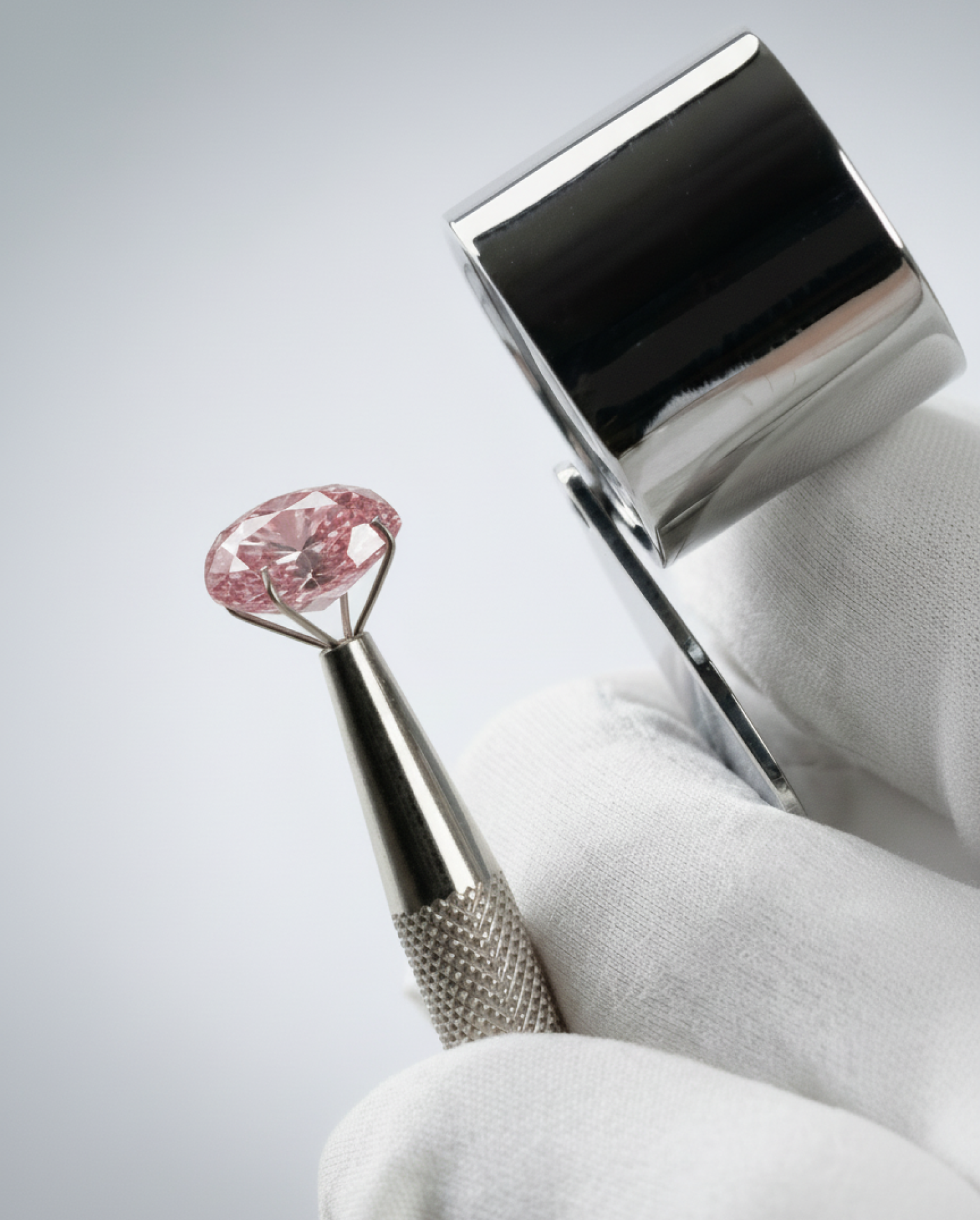
At Foxy Diamonds, a coloured stone is never chosen by specification alone. A number in a certificate is a starting point, not a conclusion. Beauty in fancy colour is defined by how tone, saturation...