




Why Lab-Grown Diamonds Are a Rational Choice
Why Lab-Grown Diamonds Are a Rational Choice
In nature, saturated fancy colours are a statistical rarity and a geological lottery. In the laboratory segment, that rarity is no longer accidental.
When you choose a lab-grown diamond, you receive:
-
The colour you actually want — not whatever happened to form underground
-
The size you need — without compromising on quality
-
Predictable, reproducible characteristics
-
A transparent, traceable origin chain
-
A price point that, in the natural category, would often be unattainable for equivalent visual quality
At the same time, production does not require mining and allows significantly better control over origin. The environmental profile depends on the energy source and the specific producer — which is why we work only with stones that carry clear traceability and documented origin.
It Is Not About "Less Than Natural" — It Is About a Different Logic
The traditional fine jewellery market has long attached symbolic value to geological rarity. For some buyers, that meaning is real and important. We respect that.
But for a growing number of people — especially those who think clearly about value — the question is different: Why should I pay a premium for geological chance when I can choose exactly what I want, at a fair price, with full transparency about where it came from?
Lab-grown diamonds answer that question directly. They are not a compromise. They are a deliberate, informed choice.
Ethics and Transparency
Conventional diamond mining carries well-documented environmental and social risks: land disruption, large-scale geological damage, complex supply chains, and in some regions, unresolved questions of origin.
Lab-grown diamonds eliminate conflict sourcing. They avoid destructive mining and large-scale geological disturbance. They provide clear traceability at every stage — from growth to certification to delivery.
This does not mean lab-grown diamonds are zero-impact. They require energy, technology, equipment, and infrastructure. All stages of production leave a mark. But they represent a more responsible and controlled alternative — one where the origin of the stone is known, documented, and independently verified.
A Brief History of Lab-Grown Diamonds
Lab-grown diamonds are not a recent trend. They are the result of over seventy years of scientific and industrial development.
1950s
Diamond synthesis becomes a reproducible industrial technology. The first crystals were microscopic and used for technical purposes — cutting tools, abrasives, industrial applications. But this decade opened the era of the "controlled mantle": the ability to recreate diamond growth conditions in a laboratory for the first time in history.
1970
General Electric produces the first small, faceted gem-quality diamonds. Early samples often showed a yellow tint due to nitrogen impurities and visible growth features — but this was the turning point. Diamond had become not only an industrial material, but a potential jewellery gemstone.
2003–2010
The first faceted CVD diamonds enter gemological practice. Initially these were small crystals, often with a brownish tint. But the technology evolves rapidly: growth accelerates, crystal sizes increase, clarity improves, and colour control becomes more precise. During this period, lab-grown diamonds begin approaching fine jewellery standards for the first time.
2007 / 2019
GIA introduces separate reports for laboratory-grown diamonds, and later standardises terminology and disclosure rules. From this point forward, certificates must state the origin of the stone, the growth method (HPHT or CVD), and any post-growth colour treatments. Lab-grown diamonds are formally established as a full-fledged category in the jewellery market — with a transparent, regulated identification system.
Today
Lab-grown diamonds are no longer an experiment or a niche technology. They are a mature industry with controlled characteristics, reproducible quality, and the ability to create rare colours and sizes without relying on geological chance. For the first time in history, the stone you choose can be designed — not discovered.
Read more
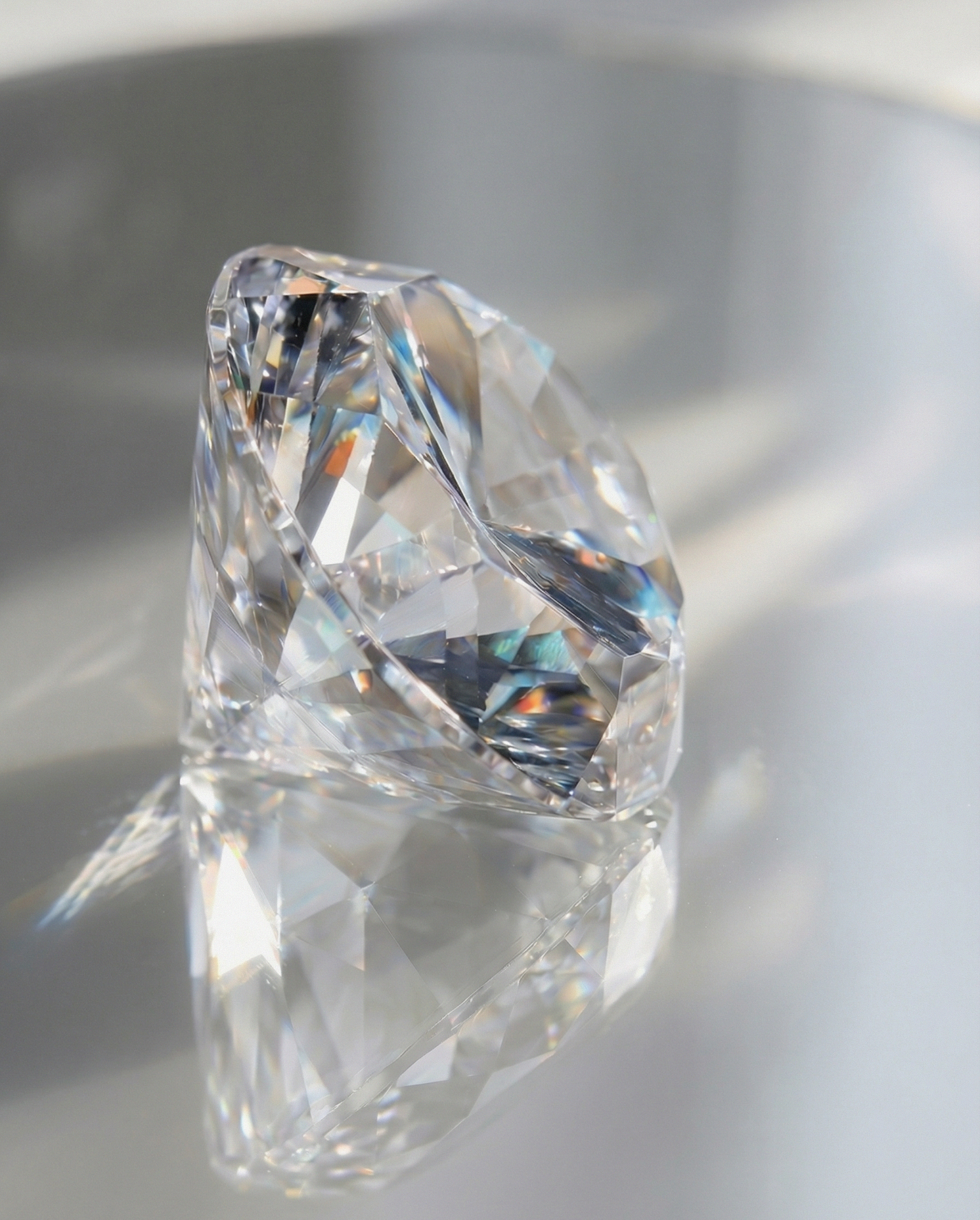
What Is a Lab-Grown Diamond? A lab-grown diamond is a diamond in the full physical sense of the word. It is the same crystal of carbon with an sp³ lattice, with the same optical, physical, and chem...

Cut — The Key to a Diamond’s Brilliance Cut is one of the four main parameters used to evaluate a diamond within the 4C system (Cut, Color, Clarity, Carat), established by the international GIA sta...